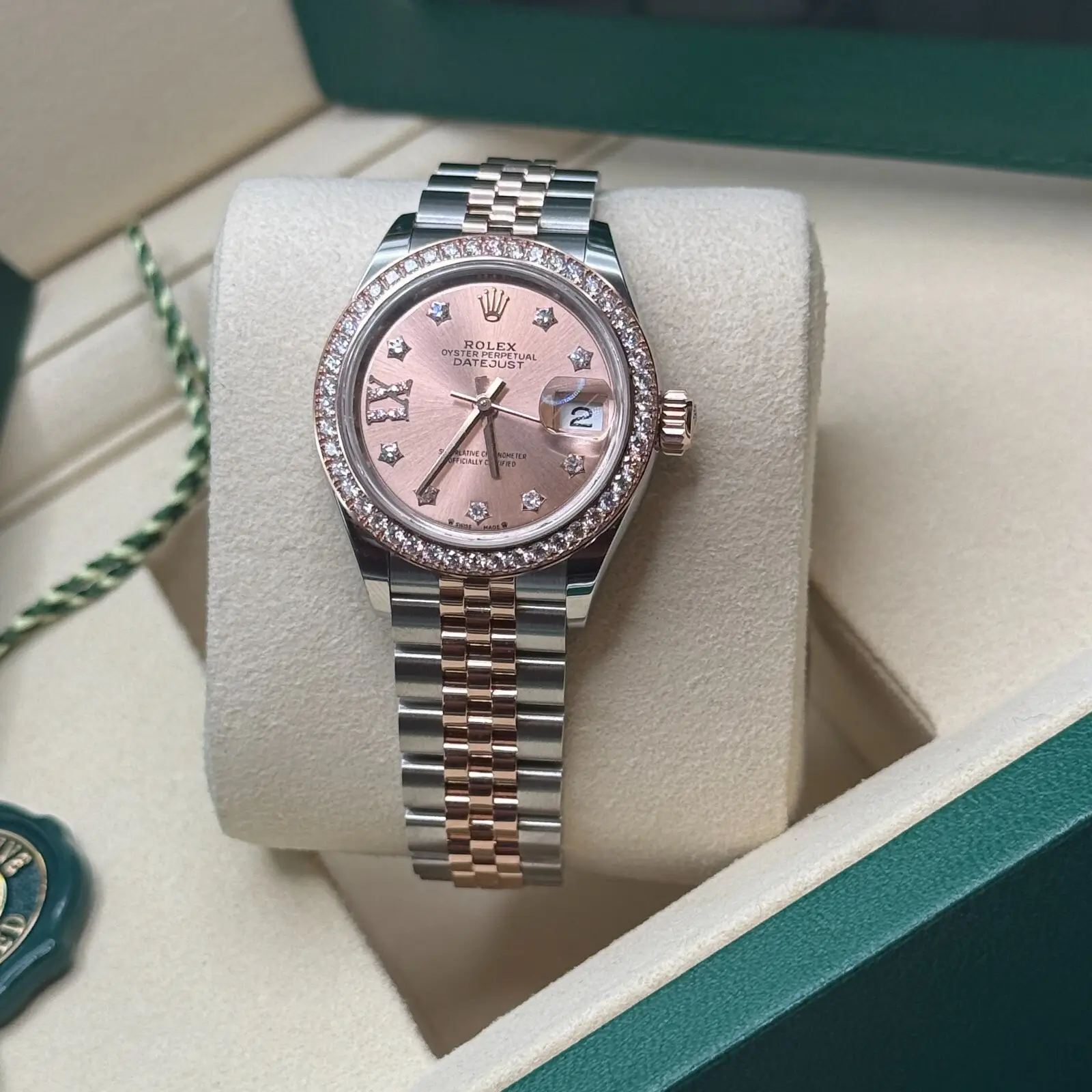
Buying a women's Rolex is often treated as a simple product-selection exercise. In practice, it is a multi-variable decision involving model architecture, wrist proportion, material, acquisition cost, maintenance requirements and secondary-market liquidity. The wrong decision is not necessarily buying the “wrong” Rolex. More often, regret comes from a mismatch between the watch and the owner's actual use.
A 28mm Lady-Datejust may be technically appropriate but visually too traditional for someone who prefers contemporary proportions. A 36mm model may have stronger versatility but feel too large on a smaller wrist. A gold configuration may offer greater visual presence, while also substantially increasing the initial capital committed to the purchase. This guide provides a structured framework for choosing the right women's Rolex.
Rather than ranking watches according to subjective preference, it examines the main product categories, size-selection logic, retail pricing, secondary-market entry points, ownership costs and acquisition channels. The objective is straightforward: reduce the risk of buying a Rolex that does not fit your wrist, lifestyle, budget or long-term ownership expectations.
What Is the Best Rolex Watch for Women?
There is no single objectively “best” Rolex for every woman. The most appropriate choice depends on how the watch will be used. For most buyers comparing a women's Rolex watch, three product architectures form the main decision framework: Oyster Perpetual, Datejust and Day-Date. The Lady-Datejust should also be considered because it remains one of Rolex's most important purpose-designed smaller collections.
Oyster Perpetual: The Lowest-Complexity Choice
The Oyster Perpetual is structurally the simplest option in the Rolex catalogue. Its importance is historical as well as commercial. Rolex introduced the waterproof Oyster case in 1926. The company subsequently developed the Perpetual self-winding system, with the Perpetual rotor becoming a defining part of Rolex's automatic watch architecture in 1931.
The modern Oyster Perpetual therefore represents the most direct expression of these foundational technologies: a waterproof Oyster case combined with an automatic mechanical movement. For buyers, the practical advantage is simplicity. There is no date display to adjust and fewer decorative elements competing for visual attention. This makes the Oyster Perpetual particularly suitable for buyers who want a women's Rolex that can move between office, travel and casual use without appearing overly formal.
Its limitation is equally clear: buyers looking for the visual identity traditionally associated with Rolex may find the design too restrained.
Lady-Datejust: The Traditional Women's Rolex
The Lady-Datejust occupies a more specific position. The collection was introduced in 1957 and combined the Datejust concept with a smaller case format intended for a more traditional ladies' watch profile. The current 28mm Lady-Datejust is particularly relevant for buyers seeking a compact, jewellery-oriented Rolex with practical daily functionality.
Its distinguishing features can include: •A date display with Cyclops lens •Jubilee or Oyster bracelet configurations •Fluted, domed or gem-set bezels •Oystersteel, Rolesor and precious-metal versions •Diamond-set dial options This makes the Lady-Datejust more configurable than the Oyster Perpetual. However, buyers should understand that configuration has a significant effect on both appearance and acquisition cost.
A steel model with a plain dial occupies a very different market position from an Everose-gold model with diamonds.
Why the Syloxi Hairspring Matters
Certain Lady-Datejust models use Rolex's Calibre 2236, which incorporates the Syloxi hairspring. The relevance of a silicon hairspring is primarily mechanical rather than cosmetic. Silicon is not affected by magnetic fields in the same way as conventional metallic hairspring materials, and its physical properties also provide high stability against environmental variation. In practical terms, this reduces one source of timing disturbance associated with magnetic exposure in modern daily environments.
Electronic devices, magnetic clasps and other equipment can expose a mechanical watch to magnetic fields. A silicon hairspring helps reduce the movement's sensitivity to this particular variable. This should not be interpreted as meaning that a silicon hairspring eliminates every possible source of accuracy variation. Shock, lubrication condition, regulation and service history continue to affect long-term performance.
Datejust: The Most Versatile Middle Ground
The Datejust was introduced in 1945 and remains one of Rolex's most versatile collection architectures. For women considering 31mm or 36mm sizes, the Datejust often provides the broadest balance between traditional Rolex identity and contemporary wearability. Compared with a Lady-Datejust, a Datejust 31 or 36 provides greater visual presence. Compared with a Day-Date, it usually requires a substantially lower capital commitment.
This makes it a logical choice for buyers who want one watch to perform several roles: •Business wear •Daily use •Formal occasions •Travel •Long-term ownership For many buyers, this versatility matters more than selecting the most luxurious configuration.
Day-Date 36: The Top-End Configuration
The Day-Date occupies a different category. It is positioned as a precious-metal collection and combines the day-of-the-week display with the date function. Its material specification and bracelet architecture place it above the Oyster Perpetual and standard Datejust configurations in both retail pricing and visual positioning. The Day-Date is also associated with the nickname “President.” This nickname is commonly linked to U.S. President Lyndon B.
Johnson, whose public association with the Day-Date helped reinforce the collection's connection with political and business leadership. “President” is therefore widely used in the market as an informal description, although it should not be confused with the official collection name. For a women's Rolex buyer, the Day-Date 36 should be evaluated as a high-commitment luxury acquisition rather than simply a larger alternative to the Lady-Datejust.
It is most appropriate when the buyer specifically wants: •Precious-metal construction •A higher jewellery and status profile •Greater case presence •The day-and-date complication •Long-term use in formal or executive environments
Choosing by Lifestyle
For a buyer working primarily in a formal office environment, a Datejust 31 or restrained Lady-Datejust configuration generally provides more flexibility than a heavily diamond-set model. For a buyer whose wardrobe is primarily casual, an Oyster Perpetual may create fewer styling constraints. For buyers whose primary objective is high-end visual presence, precious-metal Datejust or Day-Date configurations become more relevant.
The important point is that the best Rolex for women is usually the one with the fewest compromises in the owner's actual lifestyle.
Rolex Women's Watch Size Comparison by Wrist Circumference
Size is one of the most common sources of post-purchase regret. Case diameter alone does not determine how a watch wears. Lug shape, bracelet width, bezel design and wrist geometry all affect perceived size. However, wrist circumference provides a useful starting point for narrowing the selection. The following ranges should be treated as practical guidelines rather than universal rules.
Wrist Circumference Under 5.5 Inches
For wrists below approximately 5.5 inches, a 28mm case generally produces the most traditional proportional result. A 28mm Lady-Datejust or Oyster Perpetual can sit close to the wrist without dominating it visually. This range is particularly suitable for buyers who prefer: •Traditional ladies' watch proportions •Jewellery-like appearance •Lightweight daily wear •Minimal case overhang A 31mm model can still work, but buyers should evaluate it physically rather than relying only on photographs.
Wrist Circumference Between 5.5 and 6.25 Inches
This range provides the greatest flexibility. A 28mm watch will appear refined and traditional. A 31mm watch often represents the middle ground between classic ladies' sizing and contemporary preferences. A 36mm watch can also be appropriate, particularly for buyers who prefer stronger visual presence. For many buyers in this range, 31mm is the most balanced starting point. It provides more dial visibility than 28mm while remaining materially smaller than 36mm.
Wrist Circumference Above 6.25 Inches
Buyers with wrists above approximately 6.25 inches can generally consider 31mm and 36mm models without the same risk of visual imbalance. A 36mm Datejust is increasingly relevant for women who prefer modern proportions or who want a watch that functions as a more visible central accessory. The main decision is therefore not whether a woman “can” wear 36mm. Women can wear any size that fits their preference and wrist. The more useful question is whether the larger case matches the desired visual role.
A 28mm watch can function like jewellery. A 36mm watch can function more like a traditional wristwatch with stronger visual authority.
A Practical Size Checklist
Before purchasing a women's Rolex watch, consider the following: •Measure wrist circumference rather than estimating from photographs. •Compare 28mm and 31mm physically if possible. •Consider lug-to-lug proportion, not only case diameter. •Evaluate the watch with the bracelet fitted rather than judging the case alone. •Consider how the watch looks with normal work clothing. •Check whether the preferred size still feels appropriate with casual clothing.
The current market contains strong demand across several size categories. Larger watches have remained commercially important in the broader Rolex market, while smaller and mid-size models continue to represent a substantial part of total demand. For women's Rolex buyers, this means current market fashion should not be used as the only selection criterion.
A size that is fashionable but uncomfortable or visually disproportionate creates more long-term ownership risk than choosing a smaller size that matches the wearer.
How Much Does a Rolex Cost for a Woman?
The answer depends primarily on material and configuration. Current official Rolex pricing in the United States shows how quickly the capital requirement changes once gold and diamonds are introduced. At the entry level, Oystersteel provides the lowest access point. Rolesor combinations of steel and gold increase the retail price. Full precious-metal construction and diamond settings move the watch into a significantly higher price category.
Current price points include: •Lady-Datejust, 28mm, Oystersteel — $7,800 •Lady-Datejust, 28mm, Oystersteel and white gold — $9,150 •Lady-Datejust, 28mm, Oystersteel and yellow gold — $15,100 •Lady-Datejust, 28mm, Oystersteel and Everose gold — $15,400 •Lady-Datejust, 28mm, Everose gold and diamonds — $54,150 •Day-Date 36, 36mm, white gold and diamonds — $103,350 The price progression illustrates a clear pattern. Moving from Oystersteel to Rolesor creates the first significant increase in acquisition cost.
Full gold construction produces another substantial jump, while diamond-set configurations move the watch into a considerably higher price category. Official prices can change, and specific dial and bracelet combinations may produce different prices. Buyers should therefore treat these figures as a current reference point and confirm the exact configuration before making an acquisition decision.
Why Material Creates Such Large Price Differences
The first reason is straightforward: precious metals increase the material cost. The second reason is product positioning. A steel Rolex can function as a relatively discreet daily watch. A two-tone model immediately has greater visual weight because of the gold components. A full-gold or diamond-set model operates in a different social and aesthetic category. Therefore, material selection should not be treated purely as a budget decision. It also determines how the watch communicates in different environments.
A buyer who needs one watch for frequent business travel and conservative office settings may find Oystersteel more practical. A buyer attending formal events or using the watch partly as jewellery may find a Rolesor or precious-metal configuration more appropriate. The best choice is not necessarily the most expensive material. It is the material specification that matches the intended use.
Can You Get a Rolex Under $5,000?
Yes, but the buyer must accept important constraints. The sub-$5,000 women's Rolex market is primarily a secondary-market segment. It generally does not provide access to current-production models in modern configurations. Instead, buyers are more likely to encounter older references, smaller case sizes and watches with greater age-related variation. A typical example is an older 26mm stainless-steel Lady-Datejust.
Depending on reference, condition, bracelet stretch, service history, dial originality and whether box and papers are included, older examples may appear in the approximate $2,500 to $5,000 range. This price level should not automatically be interpreted as “cheap Rolex.” A lower purchase price may be offset by future servicing requirements.
Typical Secondary-Market Price Tiers
The following ranges should be treated as broad market references rather than guaranteed transaction prices. •Entry Vintage — $2,500–$5,000This segment typically includes older 26mm stainless-steel Lady-Datejust models. Prices can vary significantly depending on condition, production year and bracelet wear. •Mid-Level Pre-Owned — $6,000–$12,000Buyers in this range may find modern or relatively recent 28mm Oystersteel models, as well as selected two-tone Lady-Datejust configurations.
•Precious-Metal Market — $20,000–$45,000This tier generally includes selected 18k gold Day-Date 36 models and higher-specification jewellery-oriented Rolex watches. •Rare High-End Configurations — $45,000–$80,000+This category may include uncommon precious-metal models, platinum configurations and highly specialised diamond-set watches. The actual secondary-market value of a Rolex is highly configuration-specific.
Two watches with the same collection name can trade at materially different prices because of: •Production year •Dial configuration •Precious-metal content •Bracelet condition •Originality of components •Service history •Box and papers •Regional demand •Dealer inventory conditions
The Investment Misconception
One of the most common mistakes is treating every Rolex as a financial investment. Rolex has strong brand recognition and many references demonstrate substantial secondary-market liquidity. However, liquidity is not the same as guaranteed appreciation. Most standard-production women's Rolex models should be evaluated primarily as durable luxury goods. Some references, rare dials and unusual configurations may behave differently, but these are exceptions rather than a universal rule.
A buyer whose main objective is financial return should not assume that a standard Lady-Datejust will appreciate simply because it carries the Rolex name. For most owners, the more rational framework is: Purchase price – maintenance costs – expected resale value = long-term economic cost of ownership. This is a more useful calculation than assuming the watch will function as a guaranteed investment asset.
Rolex Lady-Datejust Service Interval and Maintenance Costs
The purchase price is only the first part of the ownership cost. A mechanical Rolex requires periodic professional servicing to maintain accuracy, lubrication performance and water resistance. Rolex currently recommends professional servicing approximately every 10 years, depending on the model and real-life usage. Actual servicing needs can vary according to exposure, wear, water use and mechanical condition.
Why Water Resistance Changes Over Time
A watch's water resistance is not created by the metal case alone. Seals and gaskets form part of the system that prevents moisture from entering the case. These materials can age over time due to environmental exposure, temperature changes and normal use. The Lady-Datejust 28mm Oyster case is rated to 100 metres, or 330 feet, under Rolex's stated specifications.
However, this rating does not mean that an older, untested watch should automatically be treated as having the same water resistance after many years of use. Water resistance should be periodically tested, particularly if the watch is regularly exposed to water.
Expected Maintenance Considerations
A comprehensive service may include: •Movement inspection •Cleaning and lubrication •Replacement of worn components where required •Regulation •Water-resistance testing •Case and bracelet refinishing where appropriate As a broad independent-market estimate, basic mechanical luxury-watch servicing can often begin in approximately the $800 to $1,200 range, although actual Rolex service costs vary by model, condition, region and required parts. Complications and additional work can increase the final cost.
Potential cost drivers include: •Damaged movement components •Replacement parts •Dial work •Crystal replacement •Bracelet repair •Precious-metal case or bracelet refinishing Buyers of older watches should therefore avoid evaluating a purchase solely on the listing price. A lower-priced vintage watch requiring immediate servicing may have a higher effective acquisition cost than a more expensive example with documented recent maintenance.
Acquisition Strategy: Authorized Dealers vs. Secondary Market
The acquisition channel changes the risk profile of the purchase. An Authorized Dealer and the secondary market solve different problems. Neither channel is universally superior.
Buying Through an Authorized Dealer
The primary advantages include: •Factory-new condition •Official manufacturer warranty •Clear retail provenance •Access to current production references •A direct relationship with an official retail network The main limitation is availability. Certain configurations can be more difficult to obtain than others, and market demand can create uncertainty around delivery timing. Buyers should distinguish between official retail policy and market expectations.
An Authorized Dealer relationship may be commercially useful, but it does not necessarily create a guaranteed delivery date for every requested reference. Therefore, an AD purchase is most suitable for buyers who: •Want the newest available configuration •Prefer factory-new condition •Value official retail provenance •Are not under immediate time pressure
Buying Through the Secondary Market
The secondary market offers different advantages: •Immediate availability •Access to discontinued references •Greater availability of older sizes •Ability to compare multiple configurations simultaneously •Potential price advantages in selected references The trade-off is verification risk. A secondary-market buyer must assess: •Authenticity •Originality •Replacement components •Polishing history •Bracelet condition •Service history •Documentation This is particularly important for vintage and lower-priced watches.
A watch can be authentic while still containing replacement parts that affect collector value.
The Practical Decision Threshold
The secondary market is generally more rational when the buyer wants: •A discontinued size •A specific vintage reference •Immediate delivery •A lower acquisition price •A configuration not currently available through an Authorized Dealer An Authorized Dealer is generally more suitable when the buyer wants: •The latest production model •Full manufacturer retail provenance •A new watch •Official warranty coverage •No immediate need to receive the watch The decision should therefore be based on product requirements rather than the assumption that one channel is inherently safer or financially superior.
Conclusion
The right women's Rolex is not determined by price, popularity or precious-metal content alone. A rational decision begins with five questions. First, what role will the watch play? A daily watch, business watch and jewellery watch do not necessarily require the same configuration. Second, what case size matches the wrist and preferred visual proportion? For many buyers, choosing between 28mm, 31mm and 36mm is more important than choosing between two dial colours.
Third, what material matches the intended environment? Oystersteel offers the greatest visual restraint. Rolesor increases decorative presence. Full gold and diamonds substantially change both acquisition cost and the watch's social profile. Fourth, what is the realistic total cost of ownership? The purchase price should be evaluated alongside servicing, maintenance and potential future resale value. Finally, which acquisition channel best matches the required reference and delivery timeline?
The central principle is simple: do not buy a women's Rolex based solely on what appears most prestigious in a photograph or most popular in the market. Buy the configuration that remains appropriate after the novelty of the purchase has disappeared. For long-term ownership, the lowest-regret Rolex is usually the model that fits the wrist, fits the lifestyle, has an understandable maintenance profile and was purchased at a price the buyer can justify against comparable market alternatives.