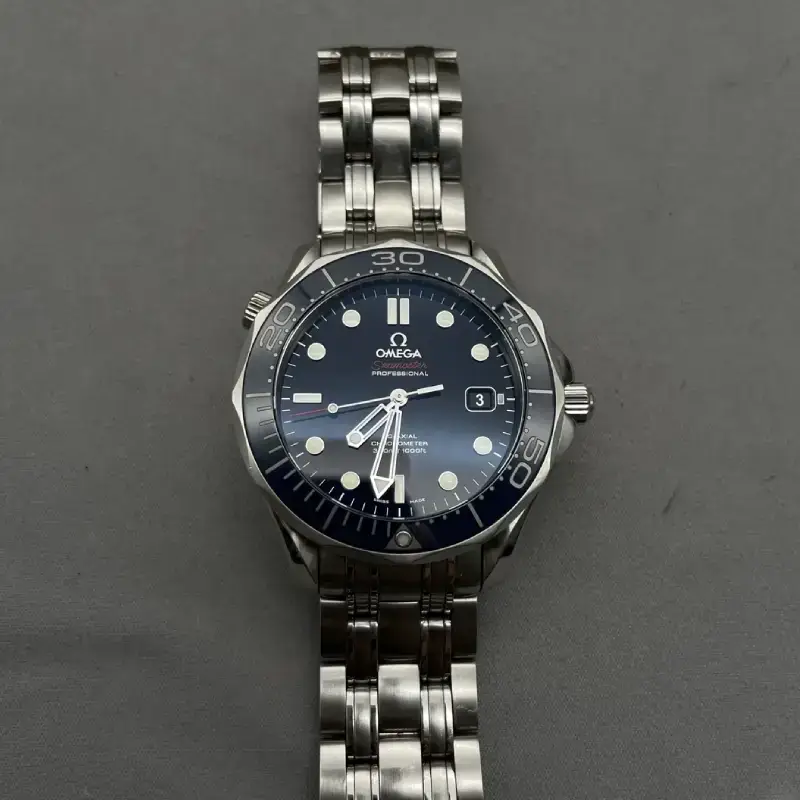
In 2026, searching for an Omega Seamaster Diver 300M on the pre-owned market can lead to a surprisingly big price gap. On one side, you have the newer Omega 210.30.42.20.03.001, which typically sells around the mid-$5,000 range on the secondary market. On the other, there is the older Omega 212.30.41.20.03.001, often available for significantly less. Both have a blue dial, stainless steel case, and the unmistakable Seamaster Diver 300M design. So why can the price difference be so large?
And more importantly, is the Omega 212.30.41.20.03.001 still worth buying in 2026? The short answer is yes—but only if you understand what you are actually buying.
What Is the Omega 212.30.41.20.03.001
?
The Omega 212.30.41.20.03.001 is an older-generation Seamaster Diver 300M that was produced during the era when the model became strongly associated with James Bond. It features a 41mm stainless steel case, a blue ceramic bezel, the classic blue wave-pattern dial, a helium escape valve at 10 o'clock, and a stainless steel bracelet. Inside is Omega's Co-Axial Calibre 2500. The watch also has a solid caseback rather than a sapphire display back.
That detail is important because it immediately separates this generation from the newer Seamaster Diver 300M. In other words, this is not simply a "cheap blue Seamaster." It is a discontinued generation with its own design, proportions, movement, and wearing experience. That distinction matters a lot when you are shopping in the pre-owned market.
Why Is the 212.30.41.20.03.001 So Much Cheaper Than the Newer Seamaster?
This is where most buyers get stuck. The newer 210.30.42.20.03.001 comes with a 42mm case and Omega's modern Calibre 8800. It offers Master Chronometer certification, strong magnetic resistance, a transparent caseback, and newer-generation technology. On paper, the newer model clearly wins. But that does not automatically make the 212 a bad buy. The lower price mainly reflects three things: •It is discontinued. •Its movement is from an older generation. •Its specifications are no longer at the cutting edge.
None of those points means the watch is obsolete. Think of it this way: the 212 is not trying to beat the latest Seamaster on technology. It is offering a different combination of size, design, movement, and price. And that is exactly where its appeal starts.
The 41mm Case Can Actually Be an Advantage
One of the biggest reasons to consider the 212 in 2026 is its 41mm case. Modern sports watches have generally grown larger over the years. The newer Seamaster Diver 300M is 42mm, which sounds like only a 1mm difference. On the wrist, however, that difference can be noticeable. For someone with a wrist around 16.5 to 17.5cm, the 41mm 212 can feel more balanced and easier to wear. It still has plenty of wrist presence, but it does not dominate the wrist in the same way some modern dive watches can.
The bracelet also helps. The classic wave-style stainless steel bracelet gives the watch a distinctive old-school Seamaster personality. It sits relatively close to the wrist and works well as an everyday bracelet. If you prefer watches that feel substantial without looking oversized, the 41mm case is one of the strongest arguments for choosing the 212 over the newer 42mm model.
What Does the 212 Look Like on the Wrist?
This is probably where the 212 makes the strongest emotional argument. The blue ceramic bezel and blue wave dial create a familiar Seamaster look, but the overall presentation feels more restrained than the latest generation. The wave pattern is printed rather than laser-engraved. That gives the dial a flatter, more traditional appearance. Under direct light, the blue can still look rich and dynamic, but it does not have the same dramatic visual effect as the modern Seamaster.
Some buyers will see that as a disadvantage. Others will see it as exactly the reason to buy the older watch. The 212 feels more connected to the Seamaster design that became famous during the Bond era. It has a slightly more traditional, tool-watch character rather than the highly polished, technically advanced feel of the latest generation. If you like vintage-inspired proportions and older Omega design language, that difference can be more important than the newer movement.
Is the Calibre 2500 Still Reliable in 2026?
The Calibre 2500 is probably the biggest concern for potential buyers. Early versions of the movement developed a reputation for issues such as stalling or stopping, particularly among some earlier production batches. That history is worth knowing. But it also needs to be put into context. The Calibre 2500 evolved over several generations, and later versions—particularly the 2500D—are generally regarded as the more mature version of the movement. That is why the production year matters when buying a used 212.
A well-maintained later-production example can be a much more attractive proposition than an early example with an unclear service history. So rather than simply asking a seller, "Does it have a 2500 movement?", ask more specific questions. Find out: •Which version of the Calibre 2500 does it use? •What year was the watch produced? •Has it been serviced? •Is there a service record? •Does the watch keep stable time? •Does the movement show any signs of stopping or irregular behavior?
A good 212 is not something you need to be afraid of. You just need to buy the right example.
Solid Caseback: Disadvantage or Hidden Benefit?
The solid caseback is another major difference between the 212 and newer Seamaster models. The newer generation gives you a sapphire display back, allowing you to see the movement. That is obviously more interesting from a mechanical-watch perspective. The 212 takes the opposite approach. You get the familiar Seamaster caseback design instead of a view of the movement. At first, that can feel like a downgrade. But there is a practical advantage. There is no sapphire exhibition glass on the back to scratch.
The watch also keeps a more traditional tool-watch feel. For a daily-wear sports watch, some owners may actually prefer that. If seeing the movement is important to you, the newer Seamaster makes more sense. If you simply want a robust watch that you can wear without constantly worrying about cosmetic damage, the solid caseback is hardly a deal-breaker.
The Specifications Still Hold Up
It is easy to look at the 212 and assume that its age makes it technically outdated. That is not really the case. You still get the core features that made the Seamaster Diver 300M popular in the first place.
The watch offers: •41mm stainless steel case •300m water resistance •Unidirectional diving bezel •Blue ceramic bezel •Helium escape valve •Co-Axial movement •Approximately 48 hours of power reserve •Stainless steel bracelet •Solid caseback •COSC-certified chronometer performance These are not entry-level specifications. Even by 2026 standards, they make the 212 a perfectly capable everyday sports watch. The biggest difference is not that the 212 cannot do the job. It is that newer watches can do more.
What Should You Pay for a 212 in 2026?
The pre-owned price is one of the biggest reasons this model remains interesting. A clean, full-set example in good condition can generally sit around the low-to-mid $4,000 range, depending on year, condition, accessories, service history, and market. Older or incomplete examples can sell for less. This is where you need to avoid one common mistake: Do not pay a premium simply because a seller calls it "rare" or "discontinued." The 212 is discontinued, but discontinued does not automatically mean collectible.
It is still a relatively accessible pre-owned Omega. A practical price evaluation should consider:
Full Set and Recent Production
A later-production watch with its original box, papers, and accessories deserves a stronger price. If the watch is from the later years of production and has a clean service history, it becomes much easier to recommend.
Single Watch or Missing Papers
A watch without its warranty card or original documentation should normally trade at a noticeable discount. The exact discount depends on condition and market demand, but you should not pay full-set money for a watch that is missing important accessories.
Over-Polished Case and Bracelet
Condition can matter more than a few hundred dollars. Look closely at the case edges, brushing, bezel, clasp, and bracelet. A heavily polished watch can lose the sharp transitions that give the 212 its original character. If the case has been aggressively refinished, negotiate accordingly.
What Should You Check Before Buying?
This is where buying a used 212 gets serious. Don't just look at the blue dial and decide that you have found a bargain. Start with the reference number. Make sure the watch is actually 212.30.41.20.03.001. Then check the movement and production details.
1. Check the Movement
Ask whether the watch has the later Calibre 2500D. If the seller cannot provide clear information, do not assume anything.
2. Inspect the Bezel
Check the blue ceramic bezel carefully. Look for chips, cracks, deep scratches, or signs that the bezel has been replaced.
3. Check the Bracelet
Make sure the bracelet has the correct links and that it is not excessively stretched. Replacement links can be expensive, so an incomplete bracelet can turn a "cheap" watch into an expensive one.
4. Check the Case
Look at the lugs and case edges. Sharp factory lines are generally preferable to a heavily polished case with rounded edges.
5. Ask About Service History
A service record can be more valuable than a seller's promise that the watch "runs perfectly." If the watch has been serviced recently by a reputable watchmaker, that can make a big difference.
Who Should Buy the Omega 212 in 2026?
The 212 makes the most sense for a very specific type of buyer. You should seriously consider it if: Your wrist is around 17.5cm or smaller. The 41mm case can offer a more balanced fit than the newer 42mm version. You like the classic Seamaster look. If you prefer the Bond-era wave dial and older bracelet design, the 212 has something the latest model cannot reproduce. You have a budget around $4,000. This is where the 212 becomes attractive.
You can get into a genuine Omega Seamaster Diver 300M without spending as much as you would on the latest generation. You don't care about seeing the movement. If a sapphire display back is not important to you, the solid caseback is not really a problem. You want a daily luxury sports watch. The 300m water resistance and robust construction make it much more than a desk watch.
Who Should Skip It?
The 212 is not for everyone. You may be better off buying the newer Seamaster if your wrist is above 18cm and you prefer a larger presence. The newer model is also the better choice if you care strongly about modern movement technology, Master Chronometer certification, high magnetic resistance, or an exhibition caseback. And if your main goal is long-term collecting or resale, the newer generation may offer stronger market liquidity. Most importantly, don't buy the 212 simply because it is cheaper.
Buy it because you actually prefer what it offers.
Is the Omega 212.30.41.20.03.001 Still Worth Buying in 2026?
Yes—but the reason is not investment potential. The Omega 212.30.41.20.03.001 is not a watch you should buy expecting it to suddenly double in value. Its real strength is value. For considerably less money than the newer Seamaster Diver 300M, you get a genuine Omega dive watch with a proven design, 300m water resistance, a Co-Axial movement, and the unmistakable look of the Bond-era Seamaster. It does not try to beat the new 210. It doesn't need to.
The 210 is newer, more technically advanced, and easier to justify if you want the latest technology. The 212 is smaller, more affordable, more traditional, and arguably more charming. And in 2026, that combination still makes a lot of sense. If you find a clean later-production example with the Calibre 2500D, complete accessories, good bracelet condition, and a reasonable price, it can be one of the smarter ways to enter the pre-owned Seamaster market.
So before you message the seller, forget the sales pitch about "discontinued rarity." Ask the questions that actually matter: 212.30.41.20.03.001. 2500D? Full set? Later production? Service history? What's your best price? If the answers are good—and the price is right—you may have just found the more interesting Seamaster.