Introduction
Few modern luxury watches trigger such immediate reactions as a Panerai watch. For some, it represents one of the strongest and most confident design identities in contemporary watchmaking. For others, it is dismissed as “all looks, little substance.” This split reaction is not accidental—it reflects how Panerai positions itself in the market. The central question is not whether Panerai watches are well designed. That point is rarely disputed.
The real issue is whether the value of a Panerai watch is built only on design, or whether design is simply the most visible layer of a much broader brand identity system. To answer that, we need to look beyond aesthetics and examine how history, design language, mechanics, product strategy, and market behavior work together.
Heritage & Origins of Panerai Watch
The story begins in 1860, in Florence on the eve of Italian unification. At the time, Giovanni Panerai was barely in his early twenties, yet driven by an intense fascination with mechanics and optics. In a narrow street near the Ponte Vecchio, he set up a small workshop and named it “Orologeria e Strumenti Ottici G. Panerai”—Giovanni Panerai Watchmaking and Optical Instruments. Beneath its modest signboard, the air was always thick with the mingled scent of machine oil and turpentine.
Europe was in the midst of the Industrial Revolution, but Giovanni chose a path that ran counter to the prevailing tide. He rejected mass-produced, poorly finished timepieces, preferring instead to spend hours hunched over a microscope polishing lenses, or bent over blueprints calculating the tiniest tolerances in gear engagement. On one occasion, an Italian naval officer arrived with a marine chronometer that was keeping erratic time.
Rather than repairing it immediately, Giovanni spent three days dismantling and studying the mechanism, eventually identifying a worn balance staff pivot as the source of the error. He machined a new pivot by hand and secured it using a self-developed micro-fusion welding technique. During subsequent sea trials, the chronometer ran for 72 consecutive hours with a deviation of no more than two seconds.
The officer reportedly exclaimed, “This isn’t repairing a watch—it’s giving the sea a pair of eyes.” It was precisely this uncompromising pursuit of precision, regardless of cost, that turned Panerai into a “hidden arsenal” of the Italian Royal Navy by the 1880s.
The workshop had no ornate display cases, only stacks of naval commissions: optical prisms calibrated for submarine periscopes, mechanical timers used to calculate the speed of torpedo boats, and marine compasses designed to remain legible even in torrential rain. Each instrument bore a tiny engraved “OP” (short for Officine Panerai) on its casing—a silent vow etched in metal: born for the sea. By the early 20th century, naval diving readiness had become a new strategic priority.
But how terrifying was the darkness of the deep? Divers of the era later recalled: “Once you descended past ten meters, even the hands of a wristwatch dissolved into vague black shadows—reading depth data was out of the question.” The navy turned to Panerai with a simple but daunting request: could an instrument be made to glow on its own in total darkness? The challenge fell to Giovanni’s son, Guglielmo Panerai.
In a report from a French laboratory, he came across a newly studied element—radium—capable of exciting phosphorescent compounds to emit continuous light. But the obstacles were formidable. Radium was radioactive and could burn the skin on contact; phosphorescent powders tended to wash away in water; and, most critically, no one at the time understood what constituted a “safe” dosage. Guglielmo made a radical decision.
He shut himself inside a small experimental room within the workshop, sectioning off a work area with lead plates and mixing radium powder while wearing thick protective gloves. On one occasion, a miscalculated formula caused the compound to erupt in a blinding blue glow, leaving a rash across the back of his hand that took three months to heal.
Yet he persisted, carefully documenting each attempt, until he arrived at what he considered the ideal formula: one gram of radium powder combined with three grams of zinc sulfide and 0.5 milliliters of a resin-based binder. This compound would later be known as Radiomir.
In 1916, when Panerai applied for a patent for this technology, the filing stated: “This material is capable of emitting light continuously for twelve hours in complete darkness and is suitable for instrument scales and hands used at depths of up to thirty meters underwater.” Less well known is how its reliability was tested.
To prove the compound’s effectiveness, Guglielmo personally descended into the Ligurian Sea wearing diving goggles coated with Radiomir, remaining on the seabed at a depth of fifteen meters for forty minutes. When he resurfaced, his lips were blue from the cold—but he held up the goggles, laughing: “Look! I can even see the shadow of my own eyelashes!” In the summer of 1936, the commander of the Italian Navy’s X Flottiglia MAS (the combat frogman unit) knocked on Panerai’s door.
They needed a watch that could follow frogmen into the most dangerous missions: “It has to be large enough to read over a diving suit, tough enough not to shatter against rocks, and accurate even after being submerged all day.” Panerai’s engineers dug through old naval order archives and found the 1916 Radiomir patent still locked away in a tin box. They decided to “revive” the technology—but first had to solve two fatal problems.
One was that a large case was prone to water ingress; the other was that radium radiation could harm the wearer. After three sleepless nights, the team came up with a cushion-shaped case. Its rounded edges dispersed impact force, while the case measured a full 17 millimeters thick and used double sealing gaskets inside to keep moisture out. The dial adopted a “sandwich” construction: the bottom layer was a copper plate coated with Radiomir, topped by a cut-out dial.
Light shining through the hollowed numerals made the lume appear to “float” behind the numbers, glowing three times brighter than a flat dial. The most ingenious solution was the crown. To prevent accidental operation, they designed a rotating locking ring: it had to be unscrewed before the time could be adjusted. This concept would later evolve into the iconic crown-protecting bridge of the Luminor line.
When the first prototype was delivered to the frogman base for testing, the divers initially complained that it was “as clumsy as a brick.” That opinion changed during a nighttime exercise. Three frogmen dove beneath an enemy vessel to plant explosives. On the return swim, their oxygen was nearly depleted, and one diver’s depth gauge failed. In that critical moment, he fumbled in the darkness for his watch.
By the faint glow of Radiomir, he was able to read his remaining oxygen and force himself back to the mother ship. Later, in his report, he wrote: “That watch was not a tool. It was our second pair of eyes.” By the 1940s, battlefield demands on wristwatches had become even more severe.
The extreme heat of the North African desert could warp cases, the humidity of the Apennine Peninsula could corrode movements, and combat frogmen were now carrying out “deep-water demolition” missions—requiring watches to remain accurate under water pressure at depths of 50 meters. Panerai’s engineers soon discovered that while the prototype’s crown could be locked, fine desert sand still worked its way through tiny gaps and jammed the gearing.
An old technician named Mario made a simple suggestion: “Why not give the crown a protective shield—like the handguard on a firearm?” The team immediately began experimenting. They wrapped the crown in a curved steel plate and shaped its end into a press-down lever, blocking sand and dust while remaining easy to operate.
When the first watch fitted with this “reinforced crown-protecting bridge” was delivered to the Navy’s testing department, one general tapped the case and said, “This guard looks like the turret of a small tank—solid and dependable.” At the same time, the hidden dangers of Radiomir began to surface. Prolonged exposure to radium radiation caused dizziness among frogmen who wore the watches for extended periods.
Panerai’s chemists combed through scientific literature and eventually found an alternative: tritium, a radioactive isotope of hydrogen. Its radiation intensity was only one three-hundredth that of radium, and it bonded stably with luminous compounds. In 1949, Panerai registered the patent for its new luminous material, “Luminor,” and throughout the 1950s gradually replaced Radiomir across all military watches.
Yet this decade also marked Panerai’s “invisible years.” Bound by military secrecy agreements, the brand was forbidden from public promotion. Its watches were distributed solely through naval logistics channels. Occasional rumors in civilian circles about “mysterious oversized watches” were embellished as tales of spy equipment.
A Florentine antique dealer once attempted to purchase a retired frogman’s watch, only to be summoned by the naval investigative division and told bluntly: “This is not merchandise—it is a weapon of the state.” The turning point came one morning in 1993. Angelo Bonati, then at the helm of Panerai, pushed open the doors of a warehouse in Florence. Inside, beneath layers of dust, lay dozens of crates containing military watches that had been sealed away for more than thirty years.
These were former Italian Navy issue pieces decommissioned in the 1980s—equipment that, by regulation, was meant to be destroyed. Bonati thought simply, “It would be a shame to throw them away.” He selected a Luminor watch from the 1950s, wiped away the rust, and found that the word “Radiomir” on the dial was still perfectly legible. In the dark, the luminous material glowed with a soft, warm green. On a whim, he sent the watch to a Geneva auction house.
During the preview, an American collector studied it under a loupe for half an hour before making an on-the-spot offer of 100,000 Swiss francs. “I’ve been searching for this kind of ‘living fossil’ military watch for twenty years,” he said. That auction went off like a bomb, detonating Panerai’s long-hidden value. By the end of 1993, the brand released its first civilian limited editions—the Radiomir 1936, a faithful re-creation of the original 1936 prototype, limited to just 500 pieces worldwide.
On launch day, a line formed outside the boutique on Fifth Avenue in New York. Some people arrived as early as three in the morning to secure a place, and collectors nearly came to blows over a single watch. The media reacted in disbelief: “How did an ‘obsolete military watch’ become the new darling of the luxury world?” The answer lay in the design itself.
Those details once regarded by the military as “purely functional excess”—the cushion-shaped case with its vintage character, the crown-protecting bridge with its industrial aesthetic, and the depth of the sandwich dial—perfectly matched the 1990s appetite for rugged, authentic retro design.
As one designer put it, “Panerai watches are not ‘ornaments.’ They are ‘tools with stories.’ Every line seems to say: ‘I have dived into the deep sea with soldiers and crossed deserts with explorers.’” After being acquired by the Richemont Group in 1997, Panerai did not simply rest on the laurels of its history.
In 2002, the brand established its manufacture in Neuchâtel, Switzerland, while firmly upholding a dual core of “Italian design and Swiss craftsmanship.” Movement development continued to be led by Italian designers, while high-precision manufacturing was entrusted to Swiss watchmakers. The creation of the first in-house movement, the P.2002, was nothing short of a marathon.
The team spent three years refining the balance wheel and hairspring, tested more than 200 different alloys, and ultimately achieved an eight-day power reserve—twice that of most automatic movements at the time. On the day the manufacture was completed in 2005, the watchmakers placed a stone monument outside the facility, engraved with a quote attributed to Giovanni Panerai: “Precision is not the goal; it is the confidence that allows humanity to go further.” This sentence became the brand’s spiritual code.
From there, the direction was clear. In 2011, Panerai introduced its bronze watches, deliberately preserving the patina that forms through oxidation as a tribute to the visible marks of time on early naval instruments. In 2015, carbon-fiber cases appeared, inspired by Formula 1 lightweight technology—60% lighter than steel, yet even more impact-resistant. By 2022, Panerai unveiled watches made from recycled titanium, sourced from reclaimed aerospace-grade materials.
Each piece carried a unique “carbon footprint number,” turning sustainability from a slogan into a new kind of adventure. Last year, during a visit to Panerai’s Milan flagship boutique, I met an elderly man with white hair. He had been a combat diver in the 1960s and was still wearing his original Luminor. “Back then, I thought this watch was ugly,” he said. “Now I see the crown guard like a small fortress, the dial like the deep sea.
Every time I raise my wrist, it feels like touching the shoulder of an old comrade.” Standing beside him was a young man dressed in streetwear, trying on the latest carbon-fiber model. “I don’t really care about the history,” he said, “but I love how it feels hardcore and rebellious—like a superhero emblem you can wear on your wrist.” That is the story of Panerai. Once a silent guardian of the deep, a life-or-death timekeeper on the battlefield, it has become a legendary symbol that transcends generations.
What has never changed is its unwavering commitment to professionalism at any cost—just as Giovanni Panerai wrote in his diary in 1860: “We do not make watches. We create humanity’s most reliable ‘second pair of eyes’ for exploring the unknown.”
Panerai Watch Brand Identity & Design DNA
The Design Elements That Define a Panerai Watch
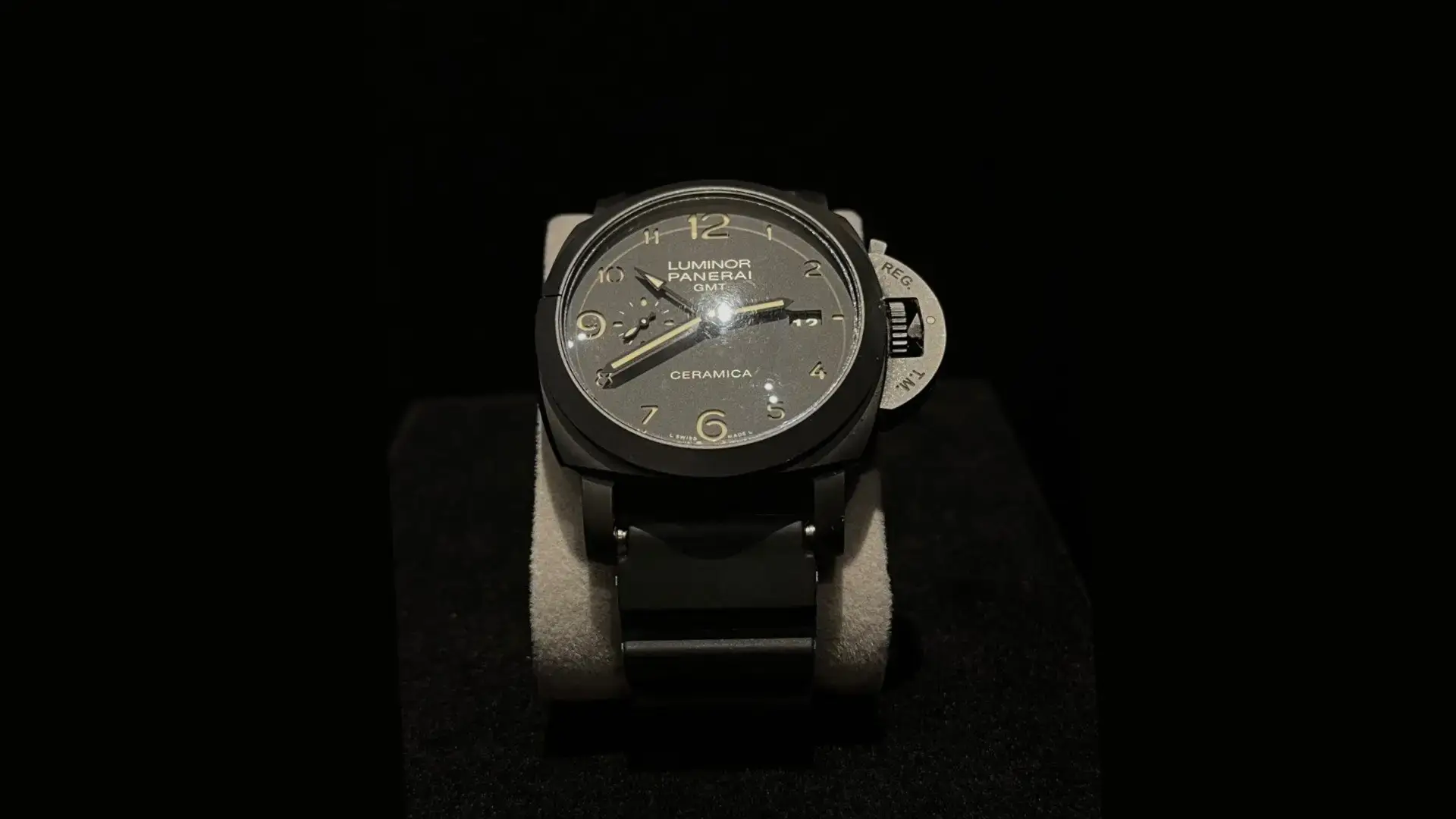
A Panerai Watch is instantly recognizable, even from across a room, often without the need to see the logo. This remarkable level of recognition is no accident,This level of recognition stems from a carefully crafted visual language, where every design element serves both function and identity. Cushion-shaped case: The distinctive case shape gives the watch visual weight and balance, creating a grounded, architectural presence that sets it apart from conventional round sports watches.
Crown-protecting bridge: Originally a purely functional element, the crown guard has evolved into one of the most iconic and identifiable features in contemporary watch design. Minimalist dial with oversized markers: The dial emphasizes legibility and clarity over ornamentation, conveying confidence and purpose rather than austerity. Integrated lug structure: The seamless transition between case and lugs reinforces the watch’s tool-like integrity and cohesive design.
Together, these features form a coherent visual language, not merely a collection of isolated styling cues. This is why Panerai Watches maintain a consistent, instantly recognizable identity across generations.
How Panerai Differs From Other Tool Watch Brands
While many luxury sports watches emphasize precision engineering, versatility, or classic elegance, Panerai stands apart through its bold Italian design and uncompromising visual identity. Unlike the Rolex Submariner, which balances robustness with a refined luxury appeal, or the Omega Seamaster, which leans toward technical sophistication and sport-elegance, Panerai watches prioritize immediate visual impact and functional clarity.
Key differentiators include: •Architectural Presence: Panerai’s cushion-shaped cases and oversized dials make a strong statement on the wrist, projecting both strength and character. Most tool watches favor subtlety; Panerai demands to be noticed. •Industrial Aesthetic with Heritage: The signature crown-protecting bridge and sandwich dial do more than look distinctive—they reference the brand’s military diving origins, giving each watch a story and a sense of purpose that competitors rarely match.
•Minimalism Meets Functionality: While other tool watches may layer on complications or decorative elements, Panerai embraces restraint. Oversized numerals and luminous markers ensure legibility in extreme conditions, emphasizing utility without sacrificing style. •Cohesive Brand DNA Across Models: Panerai maintains a consistent visual language across decades, from vintage Radiomir prototypes to modern Luminor carbon-fiber editions, creating a sense of continuity that few brands achieve.
In essence, Panerai is less about blending into a luxury watch collection and more about standing out as a tool watch with personality and history. Its design philosophy merges form and function in a way that is immediately recognizable and unmistakably Panerai.
Panerai Watch Movements & Mechanical Features
The mechanical philosophy behind a Panerai Watch has always been shaped by one central idea: mechanics exist to serve purpose, not prestige. This mindset distinguishes Panerai from many traditional Swiss watchmakers and explains why its movement history follows a different, more utilitarian trajectory. For much of the 20th century, Panerai did not pursue movement innovation in the conventional sense. As a military supplier, its priority was operational reliability under extreme conditions.
The brand relied on large, hand-wound Swiss calibers sourced from trusted partners, selected for their robustness, ease of maintenance, and tolerance for shock, pressure, and temperature variation. These movements were slow-beating, mechanically simple, and deliberately oversized—qualities that favored stability and longevity over refinement or miniaturization. This early reliance on external movements was not a limitation but a strategic choice.
Panerai’s engineering focus lay elsewhere: water resistance, legibility, crown security, and luminous performance. Movements were housed in substantial cases not as a design statement, but as a mechanical solution—allowing thicker plates, stronger bridges, and improved sealing. In this era, Panerai watches functioned as instruments, not expressions of horological artistry.
The modern mechanical identity of Panerai began to take shape in the early 2000s, when the brand transitioned toward in-house caliber development. Rather than competing directly with haute horlogerie maisons on complexity or finishing, Panerai introduced movements that reflected its historical values. Long power reserves became a defining feature, with multi-barrel constructions designed to deliver up to eight days of autonomy.
This choice echoed the brand’s military roots, where reliability over extended periods mattered more than daily winding convenience. Contemporary Panerai movements continue this philosophy of purposeful engineering. Complications are added selectively—GMT and dual-time functions for travel, power reserve indicators for practical awareness—while avoiding unnecessary mechanical density.
Finishing remains restrained and functional, reinforcing the idea that the movement is a working mechanism rather than a decorative object. Structural strength, efficiency, and clarity take precedence over visual spectacle. What ultimately defines Panerai’s mechanical character is consistency. From outsourced calibers chosen for endurance, to in-house movements designed for autonomy and robustness, the brand’s approach has remained remarkably coherent.
A Panerai watch does not seek to impress through technical excess; instead, it communicates confidence through mechanical honesty. Its movements reflect the same values as its design—functional, purposeful, and built to endure.
Panerai Watch Collections & Series Overview
The structure of Panerai Watch collections is unusually clear and disciplined, reflecting the brand’s functional origins rather than marketing-driven segmentation. Each collection represents a distinct chapter in Panerai’s evolution, defined by case architecture, historical purpose, and mechanical intent—making the lineup easy to understand, even for newcomers. Radiomir: The Origin Line The Radiomir collection represents Panerai in its purest, earliest form.
Inspired directly by the 1930s military prototypes, Radiomir watches are defined by their cushion-shaped cases, wire or integrated lugs, and minimalist dials without crown guards. This collection emphasizes historical authenticity and elegance over ruggedness, appealing to collectors who value Panerai’s origins and a more understated wrist presence. Radiomir models often feel closer to vintage military instruments than modern sports watches.
Luminor: The Iconic Identity The Luminor collection is the cornerstone of Panerai’s modern identity and its most recognizable family. Distinguished by the patented crown-protecting bridge, Luminor watches embody the brand’s tool-watch DNA at its most expressive. These models emphasize robustness, legibility, and structural presence, often paired with in-house movements and long power reserves. For many enthusiasts, Luminor is synonymous with the Panerai name itself.
Luminor Due: Contemporary Interpretation Luminor Due represents a deliberate evolution of the classic Luminor concept. Retaining the iconic crown guard and overall design language, this series introduces slimmer cases and refined proportions suitable for everyday wear. While not positioned as professional dive instruments, Luminor Due models broaden Panerai’s appeal, particularly to urban lifestyles and smaller wrists, without abandoning brand identity.
Submersible: Professional Tool Watches The Submersible collection is Panerai’s most technically oriented line, designed explicitly as a modern dive watch. With rotating bezels, enhanced water resistance, and bold case construction, Submersible models reflect contemporary professional diving standards. This series is also where Panerai experiments most aggressively with materials, including bronze, carbotech, titanium, and recycled metals.
Submersible watches represent Panerai at its most modern and performance-focused. A Cohesive Collection Strategy Unlike brands that fragment their catalogs into dozens of loosely related lines, Panerai maintains a tight collection structure. Each series—Radiomir, Luminor, Luminor Due, and Submersible—serves a clear purpose and preserves a consistent visual language. This clarity reinforces Panerai’s brand recognition and allows collectors to understand not just what a Panerai watch looks like, but why it exists.
In essence, Panerai’s collections are not about variety for its own sake. They are a structured expression of history, function, and identity—each series a different lens through which the same core philosophy is expressed.
How to Identify Authentic Panerai Watches Before Buying
Key Authentication Tips: •Case & Crown Guard: The cushion-shaped case and Luminor crown-protecting bridge should feel solid, precise, and proportionate. Loose or poorly finished parts are a red flag. •Dial & Lume: Text should be sharp with even spacing. Sandwich dials glow from underneath, not on the surface. Uneven lume can indicate a fake. •Caseback & Movement: Engravings must be deep and consistent. Movements should match the reference; in-house calibers have distinctive layouts.
•Documentation: Serial numbers must match the box and papers. Verification through Panerai service or trusted experts is recommended. Where to Buy Safely: For peace of mind, purchase only from verified platforms like iPlayWatch, Chrono24, or WatchBox. These sellers offer authentication guarantees and buyer protection.
Conclusion
Panerai is more than a distinctive silhouette on the wrist—it is a story, a philosophy, and a legacy. Its value does not rest solely on bold design; design is the visible expression of a much deeper identity shaped by decades of naval heritage, purposeful mechanics, and disciplined product strategy.
Every cushion-shaped case, crown-protecting bridge, and luminous dial reflects a commitment to clarity, durability, and function, while its collections trace a coherent path from historical military instruments to modern, technologically advanced timepieces. This cohesion—between past and present, form and function, aesthetics and utility—is what gives Panerai its polarizing yet magnetic appeal. It does not seek universal approval; it demands recognition and respect from those who understand its story.
In a world of increasingly interchangeable luxury watches, Panerai stands as a rare example of a brand where identity, history, and purpose converge—making each watch not just an accessory, but a tangible link to a legacy of exploration, innovation, and uncompromising professionalism.