Introduction
In the world of luxury watchmaking, few components carry the same level of recognition, craftsmanship, and symbolic significance as the Rolex President Bracelet. Since its debut in 1956 alongside the flagship Day‑Date, it has been closely associated with power, achievement, and distinction, gracing the wrists of countless leaders and legendary figures. More than just a bracelet, it embodies Rolex’s mastery of precious metals and reflects the brand’s dedication to crafting a symbol of refined prestige.
The Five Main Types of Rolex Bracelets
Rolex has refined its bracelet designs over more than a century of continuous watchmaking, developing a small number of distinctive bracelet types that have become integral to its identity. Each bracelet reflects a distinct design philosophy developed over decades of Rolex watchmaking, balancing robustness, wrist comfort, and visual elegance in a way that complements the watch it accompanies.
The five main types of Rolex bracelets are: Oyster Bracelet – Introduced in the 1930s, the Oyster bracelet is Rolex’s most iconic and enduring design. Its solid three-piece links provide unmatched robustness and a sporty character, making it the backbone of professional and tool watches like the Submariner and Daytona. Jubilee Bracelet – Launched in 1945 to celebrate Rolex’s 40th anniversary, the Jubilee features five finely crafted links that prioritize comfort and elegance.
Its sophisticated silhouette makes it a favorite for dressier models, such as the Datejust, while maintaining everyday wearability. President Bracelet – Exclusively crafted in precious metals, the three-link President bracelet was designed specifically for the Day-Date. Combining understated luxury with impeccable finish, it conveys status and authority without relying on overt ornamentation.
Pearlmaster Bracelet – A jewelry-oriented bracelet introduced alongside the Pearlmaster collection, the Pearlmaster showcases rounded, gem-like links that emphasize refinement and luxury. It pairs seamlessly with gem-set watches, highlighting Rolex’s high-jewelry craftsmanship. Oysterflex Bracelet – Rolex’s modern innovation, the Oysterflex merges sport functionality with elegance.
Featuring a flexible elastomer exterior reinforced with a titanium-nickel alloy blade, it combines the comfort of rubber with the durability and aesthetic refinement expected from a Rolex bracelet. These five bracelets each carry a story: whether it’s the sportiness of the Oyster, the elegance of the Jubilee, or the prestige of the President, they are inseparable from the identity of the watches they accompany.
The Origins of the Rolex President Bracelet
The story of the Rolex President Bracelet traces back to 1956—a landmark year for the brand. That year, Rolex introduced its flagship Day-Date, the world’s first self-winding wristwatch to display both the date and the day of the week in full rather than abbreviated form.
Its debut represented not only a breakthrough in movement technology and dial design but also a deliberate appeal to the refined tastes of high-ranking executives and political leaders seeking a timepiece that combined precision, prestige, and practicality. To complement this flagship watch, Rolex created an entirely new bracelet design: the President Bracelet.
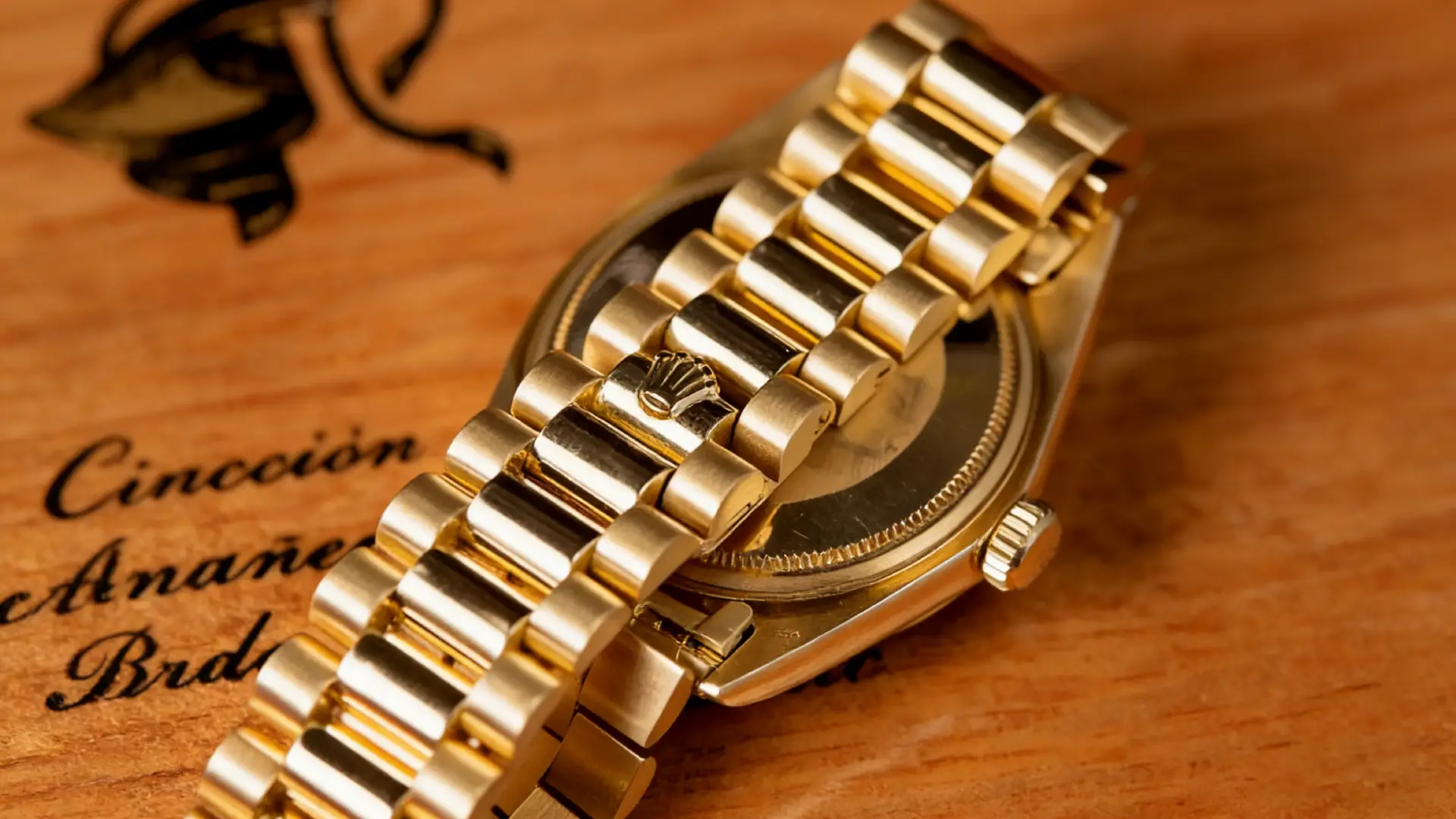
Initially crafted exclusively from precious metals—typically 18k gold or 950 platinum—it featured three broad, rounded links and a concealed folding Crownclasp, delivering both visual substance and wrist comfort. As the Day‑Date made its way onto the wrists of world leaders and influential figures, the bracelet gradually became synonymous with power and prestige. U.S. President Lyndon B. Johnson was among the earliest and most visible wearers, helping to cement the watch’s association with executive authority.
Other prominent figures—from business magnates like Henry Ford II to cultural icons such as Italian Prime Minister Giulio Andreotti—were also seen wearing the Day‑Date with its distinctive bracelet. Over time, this close association with leaders in politics, industry, and society led collectors and enthusiasts alike to refer to it simply as the “President,” a name that has endured as a symbol of achievement and distinction.
In the social and political circles of 1950s Europe and America, a watch was more than a tool—it was a marker of status and taste. The combination of the Day-Date and the President Bracelet quickly became a recognized symbol of prestige. More than a precise instrument, it served as a silent language, conveying the wearer’s influence and stature.
In this sense, the 1956 launch was not only a milestone in Rolex’s watchmaking history but also the birth of the “President watch” as an enduring icon of modern luxury horology.
How the Rolex President Bracelet Earned Its Name
Interestingly, “President bracelet” was not an official Rolex designation at the time of its introduction. The name emerged organically through association rather than marketing. As the United States entered the 1960s, political authority and economic influence were more concentrated than ever. Against this backdrop, the combination of an all-gold Day-Date and the President bracelet felt naturally aligned with the office of the presidency.
It was no longer merely a timekeeping instrument, but a visible marker of status, achievement, and taste—a symbol of power that required no explanation. Lyndon B. Johnson stands as one of the most representative wearers of this image. Known for his attention to detail and strong personal style, Johnson often used clothing and accessories to project authority and conviction.
The gold Day-Date paired with the President bracelet was bold without being ostentatious; the bracelet’s substantial proportions complemented his imposing physique, creating a visual impression of confidence and control. In doing so, the watch subtly reinforced his public identity as a decisive leader. In fact, even before Johnson, American presidents such as Dwight D. Eisenhower had been photographed wearing the Rolex Day-Date.
As these images circulated through the media, the watch gradually became associated with the presidency itself. Johnson’s choice was therefore not a matter of personal preference alone, but a continuation of an established symbolic tradition—one that leveraged a familiar visual language to strengthen his leadership image.
Rolex, keenly aware of this cultural resonance, reinforced the connection through print advertisements in American magazines using the phrase “The President’s Watch,” further elevating the Day-Date and its President bracelet as enduring symbols of power and success.
Design Origins and Construction of the Rolex President Bracelet
The most defining feature of the President bracelet lies in its three-row, semi-circular curved link construction. Each rounded link follows the natural contour of the wrist, allowing the bracelet to drape fluidly in motion while maintaining a graceful, continuous arc when at rest. Compared with flat, rigid link designs, this sculpted geometry delivers a wearing experience closer to that of fine jewelry, transforming weight into a sense of stability and reassurance rather than burden.
Every link is crafted from solid precious metal, including 18k yellow gold, white gold, Everose gold, or the rarer 950 platinum. Each material presents a distinct visual character under light—from the warm glow of yellow gold to the cool restraint of white gold and platinum, and the subtle warmth of Everose gold.
Together, they define the President bracelet’s quiet, enduring expression of luxury, reinforcing its role as an exclusive companion to Rolex’s flagship watch through both tactile presence and substantial weight. The clasp design marks a key stage in the evolution of the President bracelet. Modern examples feature a concealed Crownclasp, which disappears almost entirely within the links when closed, creating a seamless, uninterrupted silhouette accented only by a discreet Rolex coronet.
Earlier versions employed a more traditional visible clasp, with clearer structural definition and a stronger functional emphasis, reflecting the utilitarian design language of the 1950s. The transition between the two represents more than technical refinement—it signals a shift from visible mechanics to invisible perfection. Finishing completes the bracelet’s character. Each link is fully polished to a mirror-like surface, producing a soft, controlled reflection rather than excessive brilliance.
As the wrist moves, light flows gently across the curved surfaces, enhancing both visual depth and a sense of cohesion. This high-polish treatment is not merely decorative; it elevates the bracelet into a long-term wearing experience defined by touch, weight, and light—an expression of luxury meant to be felt as much as seen.
Evolution of the President Bracelet Over Time
Since its debut in 1956, the Rolex President Bracelet has maintained its core identity—three rounded links, precious-metal construction, and seamless design—while undergoing careful refinements. 1956–Early 1960s Launched with the Day-Date, crafted in solid 18k gold or 950 platinum. Its three semi-circular links offered a substantial profile, and the early folding clasp provided secure, functional closure.
Late 1960s–1980s Link articulation was refined for greater comfort, metal options expanded to include white gold, and proportions were standardized across Day-Date models to enhance visual harmony. 1990s–Early 2000s The hidden Crownclasp was introduced for a seamless flow, mirror-polished finishes created a jewelry-like effect, and subtle adjustments to link geometry improved both aesthetics and wearability.
2010s–Present Manufacturing tolerances tightened for improved durability, case-size adjustments accommodated contemporary models, and the bracelet remains exclusive to the Day-Date, preserving its identity and prestige. Over nearly seven decades, the President Bracelet has evolved carefully, maintaining its elegance and authority while adapting to modern wearability and craftsmanship standards
Conclusion
The Rolex President Bracelet is more than a showcase of refined craftsmanship—it embodies continuity, authority, and the timeless prestige of the Rolex Day-Date. Across decades, subtle refinements have preserved its elegance, ensuring it remains an exclusive symbol of status and distinction. Today, it continues to define Rolex’s most prestigious watch, standing as one of the most recognizable and culturally significant bracelets in luxury watchmaking.
FAQ
What is the Rolex President Bracelet? A three-link, precious-metal bracelet designed exclusively for the Rolex Day-Date. When was the Rolex President Bracelet introduced? In 1956, alongside the launch of the Day-Date. Why is it called the President bracelet? The name originated informally due to its association with world leaders and U.S. presidents. Is the President bracelet exclusive to the Day-Date? Yes. Rolex does not pair it with other collections. What materials are used in the President bracelet?
Only 18k gold (yellow, white, Everose) and platinum. Does the President bracelet affect a watch’s value? Absolutely. Condition and originality significantly influence secondary market pricing.