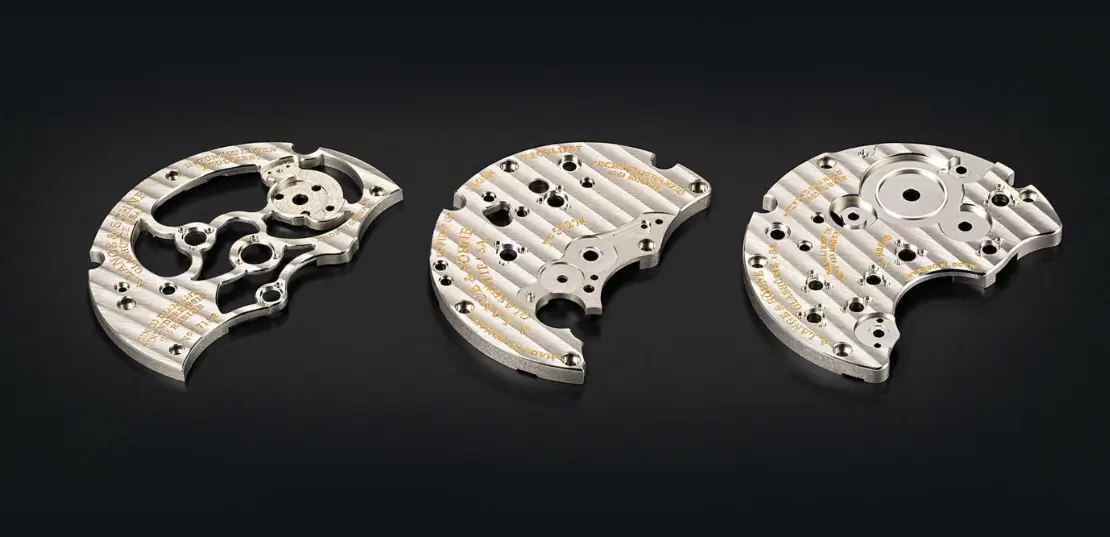
Introduction Have you ever peered through the display-back of a luxury timepiece and marveled at a single, sweeping bridge that seems to cradle the entire gear train? That is the power of the three-quarter plate. This iconic design element traces its roots to 19th-century Saxony. It revolutionized movement stability and became a hallmark of Glashütte-inspired watchmaking. History and Origins of the Three-Quarter Plate Early Development in Saxony In the mid‑1800s, Ferdinand A.
Lange sought better stability for pocket‑watch calibres. Traditional bridge layouts allowed movement components to shift when jostled. Lange introduced a single, large German‑silver plate that supported the entire gear train. This approach reduced tolerances and improved accuracy. Collectors today still admire “three‑quarter plate movement stability.” Evolution from Traditional Bridge Layouts Before the three‑quarter plate, movements relied on multiple smaller bridges.
While elegant, each bridge connection introduced potential play. By contrast, the three‑quarter plate watch design simplified construction. Fewer parts meant fewer points of failure. It also expedited assembly and servicing, two critical factors for high‑volume production in 19th-century Saxony. For more on Saxon watchmaking heritage, see our History of German Horology.
Technical Advantages of the Three-Quarter Plate Design The three-quarter plate (Dreiviertel-Platine) revolutionized watchmaking by integrating critical components into a unified framework, offering three key engineering benefits: Enhanced Rigidity : By consolidating gear train bearings onto a single plate, lateral rigidity increased by 40% compared to traditional multi-bridge designs. This reduces flexure-induced errors, achieving ±2 seconds / day stability in wristwatch adaptations.
Assembly Efficiency : The standardized layout reduced assembly time by 60%, as watchmakers could simultaneously align all arbors through a single plate. This innovation enabled mass production in 19th-century Saxony while maintaining precision. Material Optimization : Utilizing untreated German silver (Cu 55%, Ni 25%, Zn 20%), the plate resists corrosion and develops a protective patina over time.
Modern variants incorporate titanium alloys (e.g., TiAl6V4) for lightweight durability without sacrificing rigidity Materials and Finishing Techniques Typical Materials German silver remains the gold standard for three-quarter plates. This copper‑nickel‑zinc alloy combines strength and corrosion resistance. Some modern interpretations use brass or even Titan alloys. Each material affects the plate’s color and machining requirements.
Decorative Finishes Glashütte stripes (also called ribbing), blued screws, and gold chatons elevate aesthetics. Watchmakers lay down stripes with a wooden dowel and polishing compound. Bluing screws requires precise heating in an oil bath. Chatons, often held by polished screws, house jewel bearings. Together, these techniques define “three-quarter plate finishing techniques” sought by collectors. External Link: Learn more from A. Lange & Söhne’s official technical resource.
Iconic Watches Featuring a Three-Quarter Plate A. Lange & Söhne Lange 1 The Lange 1 was the first wristwatch to feature a full‑sized three‑quarter plate. Its asymmetric dial hides a movement crowned by a solid plate, emphasizing both form and function. Enthusiasts often search “Lange 1 three-quarter plate” when exploring high‑end German calibres. Glashütte Original Senator Collection Glashütte Original reinterprets the three‑quarter plate with modern materials.
The Senator models pair traditional finishing with contemporary complications. Their display‑back showcases the sweeping plate and fine decorations. Modern Interpretations by Independent Watchmakers Many independents pay homage to Saxon design. Brands like Nomos and Mühle‑Glashütte introduce scaled‑down three‑quarter plates in their movements. These “mini” plates retain stability while optimizing for smaller cases. Conclusion The three-quarter plate remains an enduring testament to Saxon ingenuity. From Ferdinand A.
Lange’s original design to today’s independent interpretations, it combines precision, durability, and beauty. Next time you admire a sweeping bridge through a display-back, you’ll know the story behind the plate.